The Quantum Effect, SMAC San Marco Art Centre Venice, until November 23, 2025
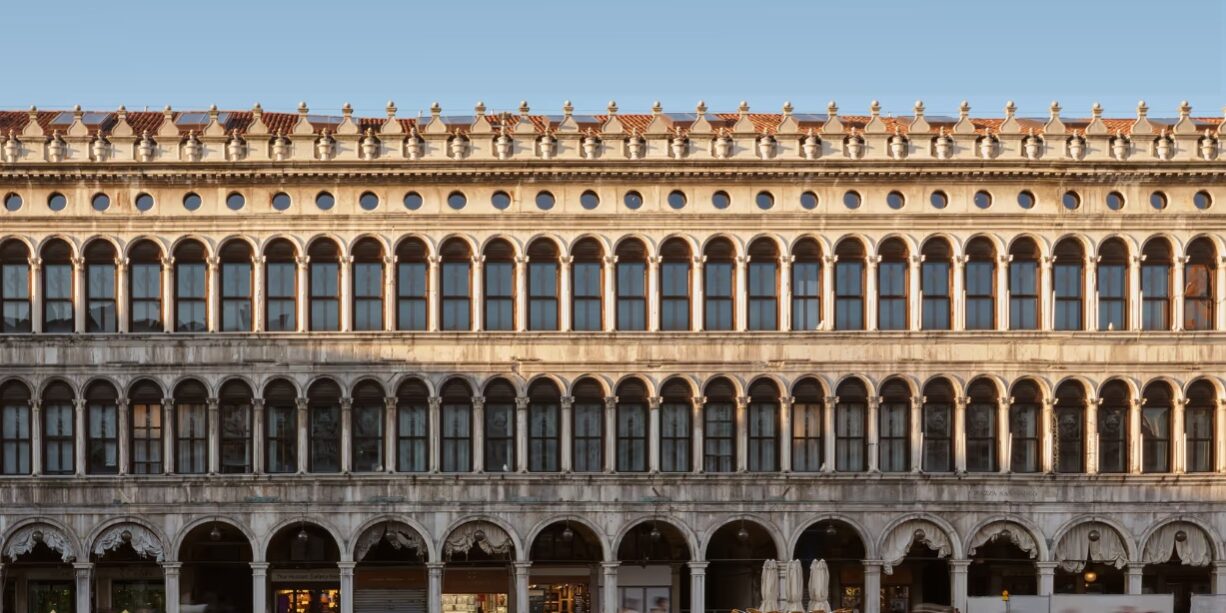
In recent weeks, the exhibition The Quantum Effect opened in Venice at the new SMAC San Marco Art Centre. Curated by Daniel Birnbaum and Jacqui Davies and produced by Officine Grandi Riparazioni Torino, the show explores the themes of quantum physics through the languages of science and contemporary art. The exhibition unfolds along two mirrored paths across sixteen rooms, evoking the concepts of symmetry, entanglement, and parallel universes. Works and installations on one side correspond to those on the other, woven into a film-like narrative that draws on both contemporary science and the universe of science fiction and pop culture.
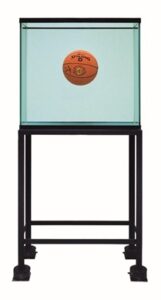
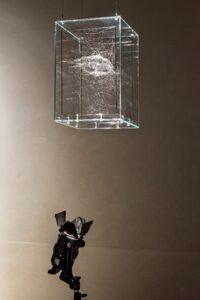
Framing and introducing the cinematic installations is a 1923 photograph by Man Ray “depicting Marcel Duchamp lying behind his first glass work.”Among the most notable works on view: One Ball 50/50 Tank (Spalding Dr. J Silver Series) (1985) by Jeff Koons, created in collaboration with physicist and Nobel Prize winner Richard Feynman; two works by Tomás Saraceno from the Hybrid Webs series, featuring spider webs enclosed in display cases. For the spider, after all, the web is a way of organizing and perceiving space and time.
The works of American artist John McCracken evoke the enigmatic monolith from Stanley Kubrick’s 2001: A Space Odyssey. The artist described them as objects that might have been brought to Earth by a UFO. “I want my sculptures to look as if they came from another dimension,” McCracken declared. He began creating these works (Plank or Black Plank) in the same years Kubrick was working on his film (written with science fiction author and inventor Arthur C. Clarke), though no direct connection was ever confirmed. As
Jacqui Davies explains, in 2020 a Utah forestry patrol helicopter discovered a three-meter metal pillar in a canyon, immediately described by some as a “monolith.” New York gallerist David Zwirner, who exhibited McCracken’s works, pointed out the resemblance to the artist’s sculptures. It was never discovered exactly who placed the pillar there or why.
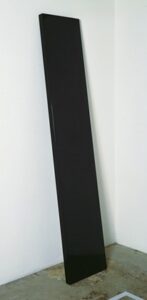
John McCracken, Planck, 1967
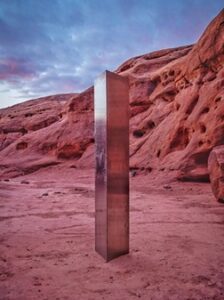
The mysterious Utah pillar, 2020
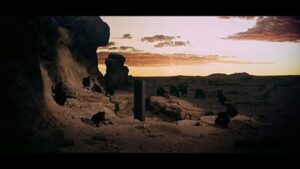
The monolith in 2001: A Space Odyssey, Stanley Kubrick, 1968
The exhibition also features famous equations and reconstructions of real scientific experiments, including the double-slit experiment, which demonstrates the wave–particle duality of matter. According to Feynman, “…it lies at the heart of quantum mechanics. In fact, it contains the only mystery.”
I asked co-curator Daniel Birnbaum whether this is an art exhibition or a scientific one. “Good question. I think it’s both—a conversation between science and art on the themes of quantum physics.”
Massimiano Bucchi